

Rambling Thoughts About Vancouver Island….
Went beach combing this clear brisk January morning with Rosie my Australian Shepherd and thought: “what a magical place Vancouver Island is!” A veritable treasure chest of breathtaking beauty tucked away on an Island 460 km long and 100 km wide… Lush green rainforests, spectacular wildlife, white snowcapped mountains, glaciers, rivers and estuaries all enveloped by 3400 km of rugged blue coastline splendour.


All in all, an inspiring day on the North Island to write about a place holding a lifetime of outdoor possibilities, for the naturalist and adventurer alike… Wonderful Vancouver Island.
The Largest Island on the Pacific Coast of North America
The Island is a unique sparkling jewel of British Columbia, and the largest Island on North America’s Pacific Coast. It is steeped in first people’s history of Coast Salish, Nuu chah nulth, and Kwakiutl tribal regions.


The Island’s Mountainous Terrain
The topography is essentially a mountainous land mass comprising of about eighteen (18) separately named ranges. Twenty-eight (28) peaks have elevations over 1900 meters (6234 feet) above sea level. The highest is the 2201 meter (7221 feet) Golden Hinde Peak located in the Strathcona Provincial Park’s Elk River Mountains.


Ranges are separated by natural valleys of colourful biodiverse ecosystems: Evergreen conifers, Maples, Alder, Dogwoods, and many other deciduous trees alongside pristine lakes; and of course, lowlands are major centres of people populations.


Island mountains are an adventurer’s hiking and climbing dream… collectively known as the “Vancouver Island Ranges”. Filled with natural trails and wildlife habitat, the system of ranges extends along the entire length of the Island forming part of the Insular Mountains… the parent range extending down Canada’s Pacific coast, from the Alaskan Panhandle, through Haida Gwaii, and eventually to the San Juan Ridge alongside the Seymour Range on the southern tip of Vancouver Island.
Vancouver Island, a Pacific Flyway Birding Stopover
But did you know the Island is strategically located underneath North America’s Pacific Flyway?


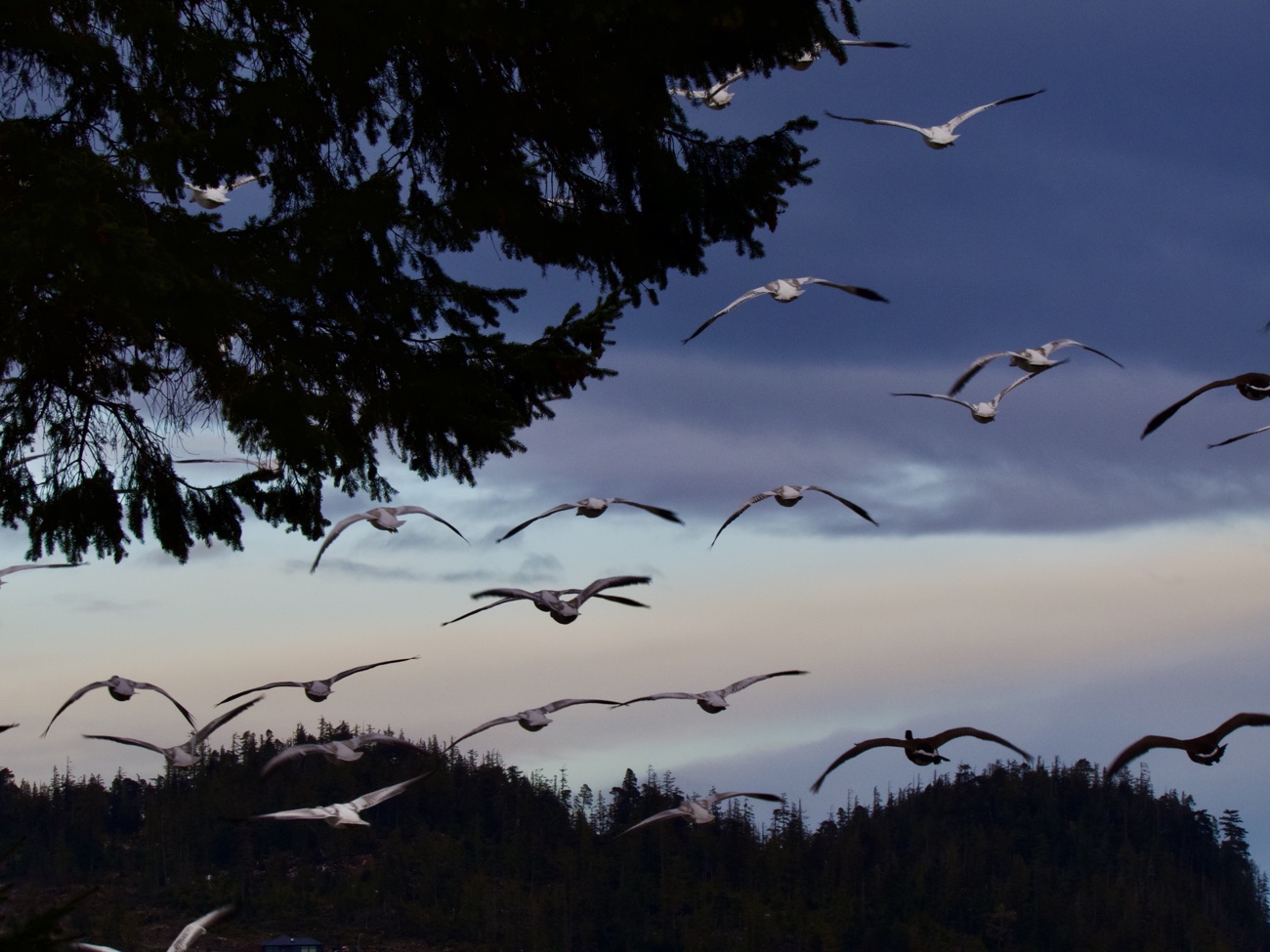
Yes, Vancouver Island lies beneath one of the world’s greatest annual migration events! The Pacific Flyway… Twice each year, in the Spring and Fall, millions upon millions of migratory birds take to the sky over Vancouver Island and fly incredible distances, following the Pacific Flyway corridor that extends from the Arctic Tundra to South America’s southern tip of Chile and Argentina.
Billions of Migratory Birds Annually Use the Flyway
The National Audubon Society estimates a billion birds use the Pacific Flyway each year. We are alerted a notion of migration by September’s high flying V’s of geese and cranes.

However the greater migration is thought to occur mostly at night and high above the Pacific Coast’s natural paradise of Islands. Some stop over on our Island’s water courses, agricultural lands, marshes, lakes, and estuaries. We are visited by an estimated 350 migrating species: songbirds, birds of prey, shore birds, ducks, geese, cranes, herons, hummingbirds, and more.


Harlequin ducks one a Merganser Saw Bill. The male Harlequin’s have amazing blue-grey, white, and rust-colored plumage
Long Distance Flight Efficiency
It is efficient for birds to fly at night, the atmosphere is more stable, making it easier to head in the right direction, especially for smaller slow flying birds. Some species are extraordinary migrators flying the entire Pacific Flyway’s 11,200 km (7000 mile) corridor, such as the Arctic Tern who holds the record for the longest annual migratory flight. To prepare for migration birds enter a state of insatiable hunger called polyphagia, causing them to eat constantly building fat stores for later energy use on their long journeys. Others make nutrient refuelling stops along the way to their chosen warm southern wintering areas such as California or Mexico. Birds are thought to navigate by sight, stars, moon, and earth’s magnetic fields.


Some Birds Fly Nonstop and Others Make Refuelling Stops
Many migrants fly nonstop and thought to sleep in micro-bursts during flight by alternately shutting down sections of the brain to sleep…. Cycling sleep between the left then the right brain as they fly allows birds to nap in the air, essentially sleeping on the wing. Isn’t this amazing!
The incredible penny weight Ruby Throated Hummingbird have been reported fly up to 2100 km (1300 miles) nonstop to reach preferred wintering grounds, some crossing huge expanses of water such as the Gulf of Mexico. The Bar-Tailed Godwit that nests in Alaskan tundra and sometimes seen staging on Vancouver Island (Cluxewe) annually flies nonstop across the Pacific Ocean for 8 or 9 days for nearly 11,000 km (7,000 miles) to wintering grounds in and around New Zealand, the longest recorded non-stop flight.
Other migrants stop, sleep, and refuel such as some Rufous Hummingbirds who may fly a staggering 5600 km (3400 miles) by making refuelling and resting stops between Alaska and southern wintering grounds as far as Mexico.
Familiar birds wintering on Vancouver Island are Green-winged Teals, Gadwalls, American Widgeons, Harlequin Ducks, Hooded Mergansers, and Black Turnstones, Plovers, Geese, Dunlins, Sandpipers, Hummingbirds, and many more. Vancouver Island is a migratory sanctuary providing refuge and critical wintering and stopover habitat for an estimated 270 bird species including sixty species of waterfowl and other waterbirds. Isn’t Vancouver Island amazing.
Safe travels
Gordon Patterson
Photos © Christine Patterson & Peter Barratt