

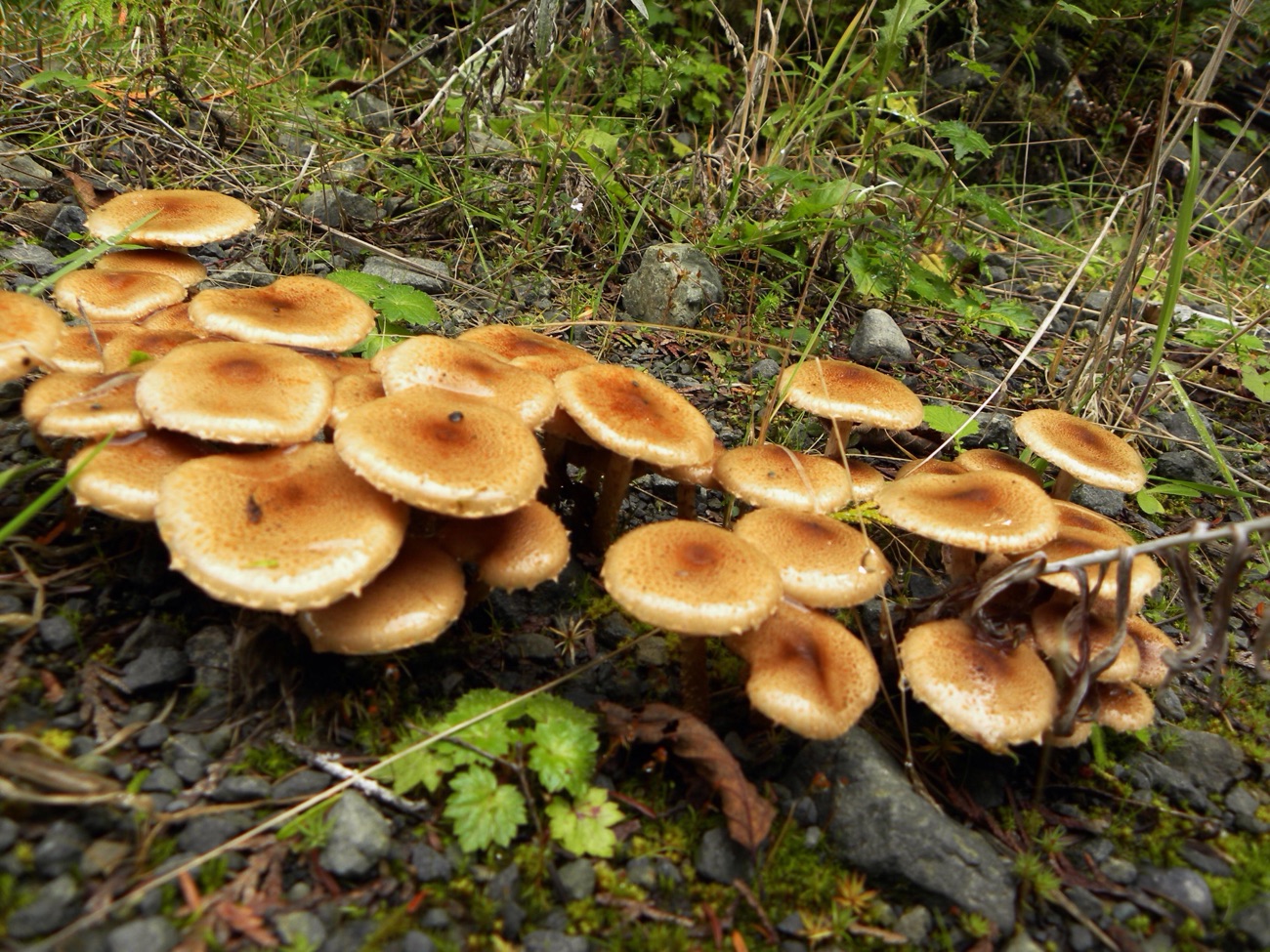
Nature’s Amazing Composters…..
It was a beauty February day on British Columbia’s North Vancouver Island…. And hiking in a nameless valley under a dark canopy of a maturing rainforest was simply a breath taking spiritual experience. Evergreen trees stretched sixty metres or more into the sky, seeking life giving sunlight… supported on huge trunks with massive root structures anchored firmly in nutrient rich soil. The trail was sided by lush green foliage even at this time of year: Sword ferns, thick curly moss, leafy salal, and more. Awesomeness…. The home of rainforest giants under the stewardship of an incredible micro world of forest fungi mycelium, the flowers of which are the fabulous world of mushrooms!


Rainforest Circle of Life
Scattered amongst the magnificent giants were slender young firs, waiting to spring upwards… when an old matriarch falls it is an act of kindness providing young offspring a canopy opening to stretch towards the sun. This is the rainforest circle of life… a process that has repeated itself millions of times over millions of acres for thousands of years. Trees are born, live, mature, produce offspring and die…. A demise that affords sunlight and growing opportunity to the next generation of monarchs.


Only sparse remnants of fallen monarchs and broken branches were seen, lying in various states of decay, victims of age, disease, or harsh winds…. You’d expect more stacks of fallen remains after millennia of being…. Yet before us lay a serene carpet of lush green vegetation harbouring a fullness of vibrant forest life. I wondered what was happening, who was nature’s composting gardener creating the natural forest parkland giving rise to the peace and serenity of this remarkable forest trail! After centuries there should be mountains of debris, no forest trails, and a dark and dismal place.


Fungi a Compositing Entity
Incredibly and fortunately Mother Nature has developed a system of cleanup and the supervising entity is the world of fungi! A strategy for decomposing wood cellulose and lignin, in a natural harmonious and coordinated decay relationship between wood, bark, microbes and fungi, that begins soon after a tree falls…. The initiation of a delicate restoration process whereby fungi mycelium facilitate the return to the earth that which the last generation took from the soil: vital organics, minerals, carbonaceous material, and essential nutrients. This is Mother Nature’s way to assure a marvellous balance of life.


Essential Fungi Relationship to the Rainforest
Stated simply, the composting relationship between fungi and fallen vegetation is absolutely essential to decompose dead vegetative fibre to natural elements creating new soil thereby creating space for the forest’s renewal cycle of regrowth, new habitat, that otherwise would not be possible. Fungi, in their quest for nutrients to grow and flower recycle the carbon, nitrogen, and organic matter of fallen trees; dead wood, roots, needles, and other vegetation debris.


Fungi and host microscopic life facilitates a self-sustaining decay process clearing and revitalizing the forest floor, enriching soil by returning metabolized nutrients back in forms that plant life can reuse, including sequestrating additional carbon from the air. Processes that give rise to natural agricultural exuberance, creating footholds for new generations of forest giants! Without fungi, forests would disappear as we know them today… Isn’t life grand!

What is Fungi
Most people envision a mushroom as a mushroom, and not as a fungus flower. A baker too, considers bread yeast as a yeast, and not as a fungus. Yet, both mushrooms and yeast are fungi, just different species!
But what exactly are fungi; do they belong to the plant or animal kingdom?… the short answer is neither, they form their own kingdom appropriately called the “Kingdom of Fungi”…. containing an ecologically diverse community of organisms that reproduce by spores and do not use chlorophyll photosynthesis for energy production. The kingdom includes lichen, mushrooms, yeasts, mildew and molds. Fungi rely on photosynthetic carbon to produce energy. Interesting eh! Their being encompass many forms, colours, habitats and species… Scientists have identified over one hundred sixty thousand species of fungi and expect that number to climb significantly. Mushrooms and fungi in this article by common colloquial names.


Most fungi have soil rooted mycelium consisting of multiple branches of fine white thread fibre (root) systems that can be microscopic or extend a few kilometres underground amassing hundreds of kilograms. Others such as yeast do not. Mushrooms we see in the forest and supermarkets are the sprouting fruit of different varieties of fungus mycelium, but not all species of mycelium bear fruit. In fact most fungi do not.


Some fungi are detrimental to living trees such as Tuftwood, Belted Conks, and Sulfur Shelf. They play a dual role in forest ecosystems, acting as both a destructive pathogen that can kill a host, as well and a wood fibre decomposer of dead trees giving rise to new forest growth
Fungi Growing Habitat
Fungi are very particular about the habitats they will grow in. Conks, Sulphur Shelf, and Oyster mushroom prefers a wood host environmentp, their mycelium a functional component in decomposition of wood; as well as providing numerous other ecological benefits to forest habitat such as an exchange of nutrients, carbon sequestration. Through symbiotic relationships, particularly with, mycorrhiza fungi, plants provide carbon for the fungi to use, and fungi in turn use this carbon to grow and deposit it in a mycelium network into the soil for long-term storage that eventually is recycled in new & old forest growth, making them crucial forest regeneration and to the global carbon cycle.


Still other fungi (mushrooms) such as the Bolete, Amanita’s, Cauliflower, and Chanterelles prefer the forest floor, seeking out roots and other debris as their preferred domain, and in the process of doing so contribute to soil and overall ecosystem revitalization.


When to see Mushrooms
Autumn is prime season for viewing forest fungi. While fungal mycelium is ever present in soil, mushroom appearance is seasonal, only appearing when soil temperature and moisture conditions are right for the particular species. Mushroom appearance is also dependent on a number of industrial, environmental, and mushroom harvesting practices affecting soil degradation and mycelium health.

In addition to the forest ecological benefits, many fungi are edible having pleasing textures full of flavour, vitamins, and proteins. Culinary delights of Pine, Chanterelle, Morel, Hedgehog, Cauliflower, Bears Tooth to name a few, are found in British Columbia’s Pacific Northwest.

Surprising Fungi Benefits to Humanity
While keeping our forest debris decomposing some fungi also sport amazing illness fighting properties. Imagine, what would the world look like today if Dr. Fleming in 1928 hadn’t discovered penicillin… isolating an infection fighting mold, identifying it as belonging to the Penicillium genus! Countless lives saved and still be saved bt this discovery!


The doctor’s accidental observation in the hallowed recesses of a laboratory led to the development of what is considered to be the first infection fighting antibiotic, revolutionizing medical therapeutics. Fleming’s curiosity and perseverance demonstrated the enormous potential hidden within the microscopic world of fungi, opening doors to new medical possibilities.
Many more fungi are actively studied today by scientists, as researchers continue to uncover their unique properties and potential applications. These ongoing investigations have led to the discovery of novel antibiotics, immunosuppressants, and even compounds with anticancer properties. Paradoxically our forest gardens of mycelium and their fruit remains a tremendously vibrant area of scientific exploration; promising further advancements that may help address the ever-evolving challenges of infectious diseases and global health concerns. Amazing eh!
Becoming a Mushroom Forager
Recreational mushroom harvesters must be aware some fungi species can have fatal consequences if ingested…. The Fly Agaric, Yellow Cap Fly Agaric, or Death Cap pictured in this article can cause death if eaten! Of particular danger is the amanita family, especially the Amanita Phalloides, or Death Cap. It smells sickly sweet and rancid when old, though at the button stage is virtually odourless. Gills/spores: underneath the cap, the gills are broad and free, pure white turning cream or even slightly pink as they age. The spores are smooth and are elliptical in shape and its spore print is white. Before harvesting any wild mushroom one should seek the advice of a mycologist, someone knowledgeable who works with fungi! The information here is for educational purposes only and should not be used for mushroom identification. One should never eat a wild mushroom unless 100% certain of its identification by an expert. Eating a poisonous mushroom can be fatal.


Mushroom poisonings are not reliably tracked however, some scientists estimate that toxic mushrooms cause about 10,000 illnesses and 100 deaths a year worldwide … The Death Cap, thought to be the most toxic mushroom is responsible for 90% of fatalities.
A safe way to start mushroom foraging is to choose a specific mushroom to hunt for (after consulting an expert) becoming familiar with the characteristics of that mushroom, learning when and where to find it…. A cardinal rule of mushroom hunting to avoid poisoning is: When in doubt, throw it out. Luckily for beginner and seasoned foragers the choicest edible mushrooms are hard to mistake for anything else. Among the most highly prized gourmet mushrooms in the world are edible mycorrhizal fungi. Included in this group are truffles, chanterelles, porcini (boletes), and morels. These distinctive mushrooms have complex life cycles and unique preferred predictable growing locations most hunters keep secret. The term mycorrhizzal refers to the symbiotic relationship between the particular fungi and the host plant’s root system.


Many foragers carry essential equipment, including a reliable field guide, a good map of the area, a small knife for cutting & cleaning stems, a collection bag or basket, and a small survival kit. Carrying such items will help in keeping the enthusiast safe, and enhance a foraging experience.


Here are some interesting little known facts about the incredible world of fungi:
- A type of Mushroom is thought to be the largest living thing on earth!
A type of honey fungus Armillaria ostoyae spanning 3.8km across the Blue Mountains in Oregon, weighing an estimated 35,000 tons! Mostly underground, this fungus is appropriately named the “Humongous Fungus”. It is considered to be the largest “single organism” on earth! - Oyster mushrooms can be Carnivorous
The mycelia in Oyster mushrooms are known to release a unique chemical that attracts certain types of worms. Once they’ve lured them in, they captured by the mycelia and digested - Yartsa Gunbu is The Most Expensive Edible Mushroom in The World
The Yartsa Gunbuo (caterpillar fungus), is a parasitic fungus that kills its host caterpillar and uses it to produce a mushroom that grows out of the caterpillar’s head. Traditional Tenetan and Chinese healers have used it to treat illnesses and boost energy and endurance. Worth tens of thousands for a 1/2 kilo, they’re one of the most expensive mushrooms in the world. Also known as Himalayan Viagra and many other names - Some Authorities Believe Fungi Allow Trees to Talk to Each Other
Mycorrhizal fungi form symbiotic relationships with host trees and plants, interacting with the plant’s roots and provide nutrients, and they get simple sugars in return. Some scientists also believe the fungi’s mycelial helps facilitate sharing of information between various plants and trees of different species warning each other about droughts, pests and diseases. - Mushrooms can create their own wind!
Some mushrooms can create their own wind to disperse spores by releasing water vapour that creates a small, localised air stream. Evaporating forces help carry spores out of the mushroom, and give the spores a little lift. The lift can carry spores up to 10 centimetres horizontally and vertically causing cells to move around the area via aka wind! - Some Mushrooms glow in the dark
There are around 80 different species of bioluminescent fungi, and researchers are discovering new glow in the dark fungi annually. Mushrooms use luciferins (light-emitting compounds) to glow as a method to attract spore dispersing insects agents. - German and Swiss scientists have identified the fungus Exidiopsis effusa as key to the formation of hair ice. The fungus was found on every hair ice sample examined by the researchers, and disabling the fungus with fungicide or hot water prevented hair ice formation.


Isn’t this stuff interesting!
Well the day is closing and evening fast approaching. Time to refill the woodstove…. I’ll close this article by saying humanity owes a debt of gratitude to the world of fungi, not only for their scientific curiosity, visual beauty, culinarily delights, and medical value, but for the amazing role they play in perpetuating the wonderful rainforest biosphere for the Wild Kingdom and the adventurous hiker alike.
Safe travels out there.
Thank you Jill Creba, your passion for the outdoors inspires!
Gord Patterson
Photos © 2024 Christine Patterson