

An Overgrown Logging Road
Before the sun gathers its strength and the world awakens, the forest holds its breath as it slowly reveals its secrets. Far from paved highways and Port Hardy lights, a quiet lays softly on the land, profound and complete on Northern Vancouver Island. The silence broken only by the faint rustling of leaves as we walked an old logging road towards an owl’s call. It is a woodland suspended, balanced between night and day, when time slows and every step is marked by soothing anticipation: what surprises will nature reveal to Chris, Rosie, and I this mid October day?
Old logging roads thread throughout most of British Columbia’s backcountry, like hidden veins connecting townships, mountains and valleys with outstanding wildlife habitat. Many are barely more than a suggestion of past industrial use. Edges blurred by time and tenacity of nature to reclaim its own. Once robust gravelled surfaces surrender to tufts of grass, fallen leaves, and low vegetation. Bracken ferns and fireweed, brown and past their prime, crowd close; beaded with drops of dew, as Alder branches arch overhead. It is a gateway to a regenerating rainforest; Pine, Hemlock, Spruce, Cedar and Douglas-fir. Leaves, needles, and small loose rock crunch softly beneath our boots.
Slowly, the sky brightened, revealing layers of drifting mist obscuring the horizon. Air damp with a heaviness press against our skin, wrapping our body and soul in the amazement of a new day. The noise of mankind was distant as another era. The uncluttered ambience so rich that every subtle sound is magnified; a drip of a dewdrop as it releases its grip from a leaf tip, a distant Raven’s call, the muted low whistle of a Varied Thrush. Daylight comes not with a shout, but in measured grace guided by Mother Nature’s gentle hand; awakening the earth slowly, bidding farewell to the night.
It is in this atmosphere of suspended wonder, a breath between each step, that we saw it! The subtle flicker of movement at the edge of vision, barely distinguishable from the jumble of awakening colours of an autumn harvest. A ruffed grouse stood motionless, half-shrouded by mist, gravel, and fallen leaves.
We could feel a tension in the bird’s posture, an alertness honed by instinct and generations of survival. Its head cocked slightly, a dark sharp eye unblinking, as if weighing our intentions. The grouse body compact yet graceful, every feather perfectly arranged, the pattern of its plumage a blending of greys and dusky creams melded seamlessly within this wooded habitat. He stood defiant in quiet dignity, and we were suddenly aware of the privilege of this moment. How long had he watched our approach? In that silent encounter the weight of our presence is palpable; we are intruders, witnessed by a creature perfectly attuned to the rhythms of this place.
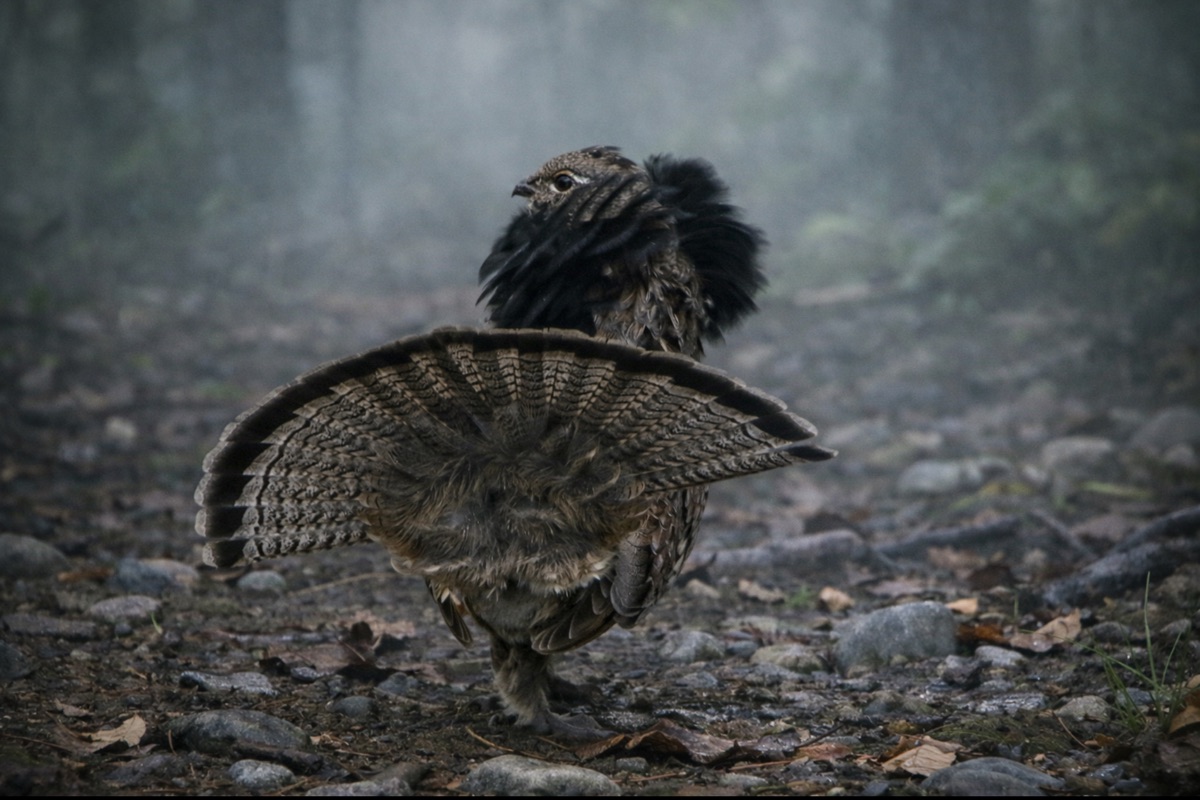
Strutting with careful steps the Grouse advanced into a patch of filtered light. He paused, then lifted his head high and in a display unique only to males spread a mottled tail in a measured fanning arc. The ruff feathers at its neck fluff, transformed the bird to a different shade of magnificent. It was a display both defensive and courtly, a gesture older than the forest itself. The ruffed feathers giving rise to his name.
The ceremony in his movement was captivating, choreographed by cycles beyond human understanding, by the changing of the seasons, by a need to mate, by an ever-present vigilance. Watching, we are keenly aware of the boundary between observer and observed, between belonging and trespass. His dance was a private ritual we just happened upon, not meant for human eyes. It filled us with humility.
Moments like this are not earned but given. The woodland did not promise us a show, nor did the grouse need to grace us with its presence. Rather, the morning offers a lesson in patience, in quietude, in the art of noticing. The encounter instilled a reverence, not just a feeling, but a practice: A willingness to tread gently, to listen deeply, to respect the sovereignty of the living natural world.


I found myself whispering thanks, a morning to remember, to carry the magnificence and beauty of this grouse forward into a story. The forest, wrapped in mist and mystery, holds countless narratives older than I can imagine. The many heartbeats awakening in secrecy, surrounded by natural splendour crafted by the hand our maker. I thought of the rarity to see a grouse fanning so close and, if only for a brief instant, to share space with such wildness, a token of the woodland’s trusting generosity.
The sun is climbing, burning away the last wisps of mist, and the forest has awakened: a woodpecker taps, a squirrel complains, leaves tumble in a rising breeze. But the wonder of dawn persists, a thread of connection that runs deeper than words.


Ruffed Grouse are birds of paradox: unobtrusive yet striking, common yet elusive. Adults typically measure between 40 to 60 centimetres long, their bodies stout but agile, perfectly adapted for sudden bursts of flight through dense cover. They come in various colour phases, ranging from grey to reddish-brown, a camouflage pattern that allows them to vanish from invading presence with ease among the mottled leaves and fallen logs. Female Ruffed Grouse (hens) are very similar in appearance to males (cocks) and differ primarily in tail length and colouring. Hens assume all parental duties after mating and craft a loose nest of twigs, grass, and leaves, directly on the ground. She will lay 9 to 14 eggs coloured from milky to cinnamon-buff, and incubate them alone for about 23 to 26 days.
Vancouver Island has its own unique species of Ruffed Grouse, having a colouring to blend into mild coastal landscapes. Their feather pattern has exquisite detail, predominantly mottled browns, beige tones, and scattered white barring. However grey phased Ruffed Grouse can also be observed. Both blend so naturally into a forest backdrop as if they are an extension of the woodland itself. The focused curious eye and raised crest give these incredible fowl a touch of mischievous personality, indignation at our intrusion.
Ever alert and full of character the Ruffed Grouse is an example of how seamlessly wildlife fits into the rhythms and textures of the habitat they inhabit. In autumn, their feathers reflect the season’s palette: russet shoulders, gray-brown backs, intricate barring on the breast, and tails edged with black or beige. The bird’s distinctive ruff, a collar of elongated feathers at the neck when raised signals both courtship and territorial defence. His springtime “drumming” to attract hens is full of promise of a new generation; their beauty and sudden flushes make Ruffed Grouse one of the forest’s most memorable inhabitants.
As we left the old logging road behind, the memory of the morning stayed with us: The scents, the shifting colours, the predawn hush, and above all the forest’s greeting ambassador, the Ruffed Grouse. We are reminded that the wild is not a spectacle to be possessed but a gift to be received, and that our best moments are those marked by humility and respect. There is unique grandness in the Wild Kingdom, in the order of all things within the circle of life.
Safe Travels,
Gord
Photo © 2026 Christine Patterson