

The Marvel of a Bird’s Eye
A brief overview.
There is a treasure between Pacific Ocean and the Coast Mountain Range. It is called Vancouver Island, a veritable bird’s paradise. From temperate rainforests, rocky coastal shorelines, to urban parks and backyards, the Island is home to a spectacular variety of birdlife. Whether hiking into San Josef’s Bay, kayaking in the Nimpkish Valley, or strolling through Hyde Creek gardens, we are greeted by amazing winged residents. Hundreds of species call this Island home, agile Barn Swallows darting through open spaces, mountain Chickadees, the ever-watchful Herring Gull patrolling shorelines, or chattering Black Turnstones foraging in the intertidal zone…. A visual odyssey waits right outside our front doors, an adventure of curiosity, wonder, and amazement.


Chris and I, like many others, are fascinated by bird life, in part by their unique way of seeing the world, a perspective shaped by optical evolution, habitat, and lifestyle. Their outstanding vision has given rise to numerous metaphors, “eye like an eagle”, “watching like a hawk”. Colloquialisms used in everyday speech emphasizing human desire to express detail and focus.
Perhaps “a bird’s eye view” is one of the more popular metaphors to describe seeing things from above, or viewing a situation in its entirety. But what if we took this expression literally? What if we imagined ourselves observing the world not just in rhetorical sense, but actually through the eye of a bird? We would experience a whole new cinematic way of processing optical information: superior colour, vibrancy, focus, and distance vision.
The intricacies of a bird’s eye are more than just a metaphor; they are a gateway to understanding Mother Nature’s ingenuity. The vision of each of our feathered friends is a result of millennia of evolutionary adaptations responding to ecological demands to eat and avoidance of being eaten. Visual adaptations among bird species, eye colour, positioning , size, reflects their varied lifestyles and habitats highlighting the intricate relationships between sensory abilities and ecological roles. The avian lens offers us a window into the remarkable ways life adapts and thrives. Every time a Bald Eagle uses his talons to snatch a salmon, or a Belted Kingfisher catches a minnow, imagine an eyesight far more vivid and detailed than ours.
Unique Eye Form and Foveae
Birds have unique eye form engineered to an avian lifestyle. Unlike the roundness of human eyeballs, many birds have eyes shaped more like tubes or oblong which allows for a larger retina surface and more light-gathering power. Birds generally possess more photoreceptor cells (cones and rods) affording sharper richer colour perceptions. Some birds, such as hawks and eagles, have two specialized retina focal regions for pinpointing details forward called foveae. Humans have just one.
Eye Positioning
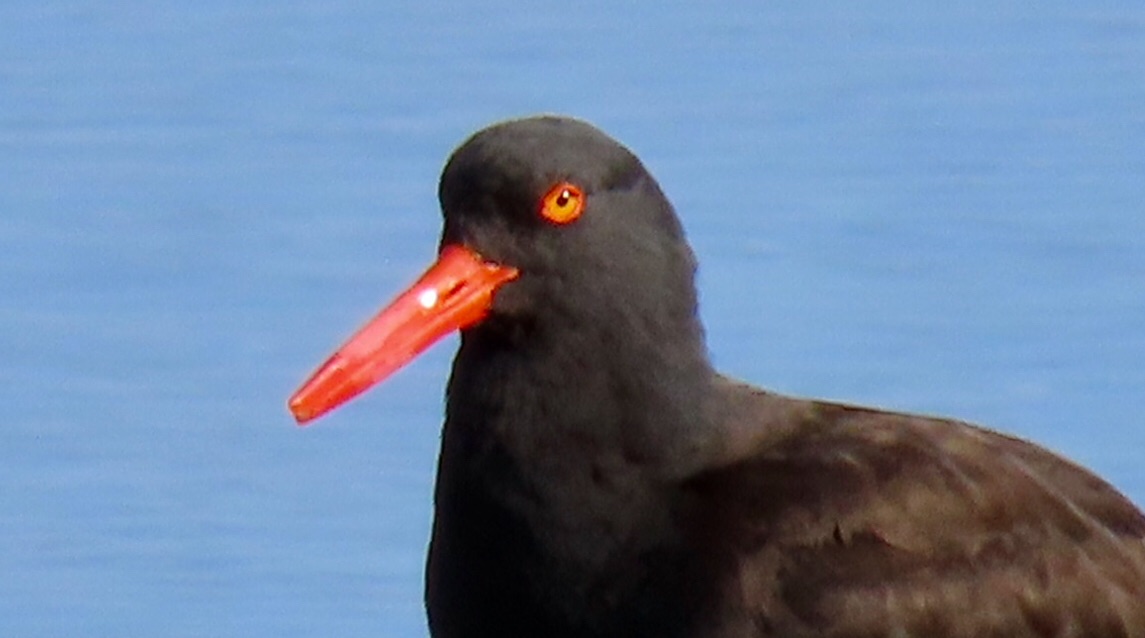
Avian eyes are often positioned species specific allowing varied fields of view and depth perception depending on their role in the Wild Kingdom. For example the Black Oystercatcher eyes are placed on the side of their skulls incorporating highly acute, specialized daytime vision that can see side to side simultaneously yet having precision to detect tiny camouflaged prey or perceive details in bright, high-glare coastal habitat. While this ability does not match that of raptors their structural adaptations allow it to flourish in intertidal zones with a clarity affording it nearly 360-degree field of view.
Colourful Perceptions
Humans see three primary colours (red, green, blue), but many birds see four when adding ultraviolet spectrum. This “tetra-chromatic” vision means flowers, feathers, and landscapes reveal secrets of vibrancy we’ll never see. Birds’ eyes are also proportionally larger, often dominating their skulls, enhancing their visual power, opening sight to a world of hidden signals and patterns.

Flexible Cornea, Binocular, & Telescoping Vision
Another amazing anatomical feature, unlike humans who rely on flexible lenses to focus, birds can shift the shape of their cornea as well as lens for rapid adjustment. They also employ a transparent third eyelid, “a clear nictitating membrane” like goggles for protection and cleaning eye surfaces, especially during perilous flight dynamics. Humans need to blink repeatedly with an opaque eyelid momentarily obscuring vision to moisturize and clean eye surfaces.
Perhaps no bird symbolizes the tag phrase “Discover your Wild Heart” quite like the Bald Eagle. With a wingspan reaching two metres, these regal hunters patrol shorelines and forests, scanning for fish, rabbits, and other prey at great distances, using their astonishing eyesight.


Bald Eagles are widely considered having the sharpest long-distance eyesight in the entire animal kingdom
Bald Eagles are believed to see up to four to eight times farther than humans, thanks to densely packed cones and dual retina focal centres. They can adjust perception to zoom in or out like a telescope. Imagine being able to spot a mouse from a kilometre away while gliding hundreds of metres above the ground! Hawk and Eagle vision is so acute that they can track moving prey even as they dive, continuously refocusing with the precision of a laser beam. This superpower shapes their role to an apex avian predator, crucial for maintaining the balance of nature in many interconnected ecosystems. Watching an eagle or hawk gracefully maneuvering overhead, is witnessing masters of focal adaptations and cunning.


Structural Eye Adaptations to Dive Eyes Open at Speeds Approaching 190 kph
Discriminating Cones & Rods and Wide Field of View
A frequent flyer in Vancouver Island woodlands is the Red-tailed Hawk. Often seen circling high in the sky over open fields or perched on a tree top, hawks possess extraordinary adaptations for spotting prey. Like the Bald Eagle, hawk eyes are positioned forward affording binocular vision and depth perception ideal for calculating distances, including a nictitating membrane acting like goggles, a must when swooping down on mice or voles at incredible velocities approaching 190 kph! Red-tailed Hawks and Bald Eagles also benefit from a wide almost 340 degree field of view, allowing them to scan large areas for movement. Their retinas are packed with cones are especially tuned to detect brown and green, perfect for picking out camouflaged animals in grassy landscapes. Hawks are not just watching; they’re reading the environment seeing the pulse of life even as it seemingly hides beneath ground cover.

Rapid Pupil Adjustment Rod Rich Retinas
If you’ve ever lingered by a shoreline, who could ever forget spotting a Great Blue Heron, standing motionless like a statue. Herons have eyes set high and forward on their heads, granting them excellent binocular vision and optical zoom like Eagles and Red-tailed Hawks, for their precision lightening fast strikes. Their pupils adjust quickly, allowing them to transition from the bright glare of open water. Herons can see into the water using rapid focus adjustments to detect fish movements that escape human notice. This unique vision, combined with their slow, deliberate stalking movements, lets them hunt with remarkable efficiency in day and night environments. Their feeding strategy relies on patience, stealth, and a visual system attuned to glare, ripples and flashes beneath the surface.


High density Photoreceptors
Among birds with extraordinary eyesight, the turkey vulture stands out for their remarkable ability to spot carrion from dizzying heights. This acuity is made possible by several specialized eye adaptations. Turkey do not have binocular vision having large eyes on the sides of their head with a high density of specialized photoreceptors. They constantly turn their heads from side to side thus enabling them to process information from each eye reading minute contrasts in landscape from several kilometres away. Their retinas contain deep foveas that sharpen focus and enhance detail, while a wide field of view ensures they remain aware of their surroundings. Unlike many other raptors, turkey vultures also rely on a highly developed sense of smell, but their visual sharpness, sensitivity to movement, and anatomical eye features combine to make them expert scavengers. These features allow turkey vultures to efficiently locate food and fulfill ecological niche as nature’s clean-up crew.


Polarized Light and Colour Sensitivity
The American Robin is a familiar sight in woodlands, gardens, and parks all across Vancouver Island. Unlike raptors, robins rely on their colour vision to forage for berries, worms, and insects. Their eyes detect subtle hues and contrasts in grass and soil we do not see. These red breasted wonders are sensitive to polarized light, giving an ability to pick out insects and worms in ground glare. Their vision supports hunting success in urban area’s bright surfaces and manicured green lawns, allowing these cheerful critters to thrive in human-altered landscapes. Watching a robin hop across a lawn is to witness an expert observer, attuned to both woodland and urban cues.
Remarkable Sight Better than Humans
At the end of the day birds see the world in ways we can only imagine. Their colour vision extends into ultraviolet, revealing patterns on flowers and feathers that are invisible to us. Eagles, vultures, and hawks can resolve fine details at great distances, while herons and owls dominate the night with their rod-rich retinas. Birds’ eyes are proportionately larger and more sensitive, tuned to the demands of their lifestyle. Where humans miss a camouflaged mouse or distant movement, birds catch every nuance. Some species, such as robins, can detect polarized light, aids to foraging and navigating dense grassy areas. Specific visual adaptations highlight evolutionary pressures shaping vision whether for hunting, foraging, migration, or social interaction. Birds respond to threats and opportunities that elude human eyes. They find mates based on visual cues, avoid predators, and exploit resources with precision. The avian world is richer, more colourful, reacting to light signals that guide their lives.
Returning to my opening metaphor, “a bird’s eye view” is not just about looking from above; it’s about seeing things differently. By observing birds, we learn to appreciate diversity, resilience, ingenuity. Perhaps the greatest gift of a “bird’s eye view” is an invitation to see anew. To step outside our limited human capacity and comfort zone and imagine a world filled with ultraviolet light, distant clarity, and subtle movements a kilometre away.
The wonder of an avian eye goes beyond simple biological curiosity; it’s truly a source of amazement and inspiration. So grab your binoculars, step outside, and join Chris, Rosie, and myself as we explore what our feathered friends see and experience. The great outdoors is a world of discovery full of colour waiting for us to take in its wonderful sights.
Safe Travels,
Gord
Photographs © 2026 Christine Patterson