

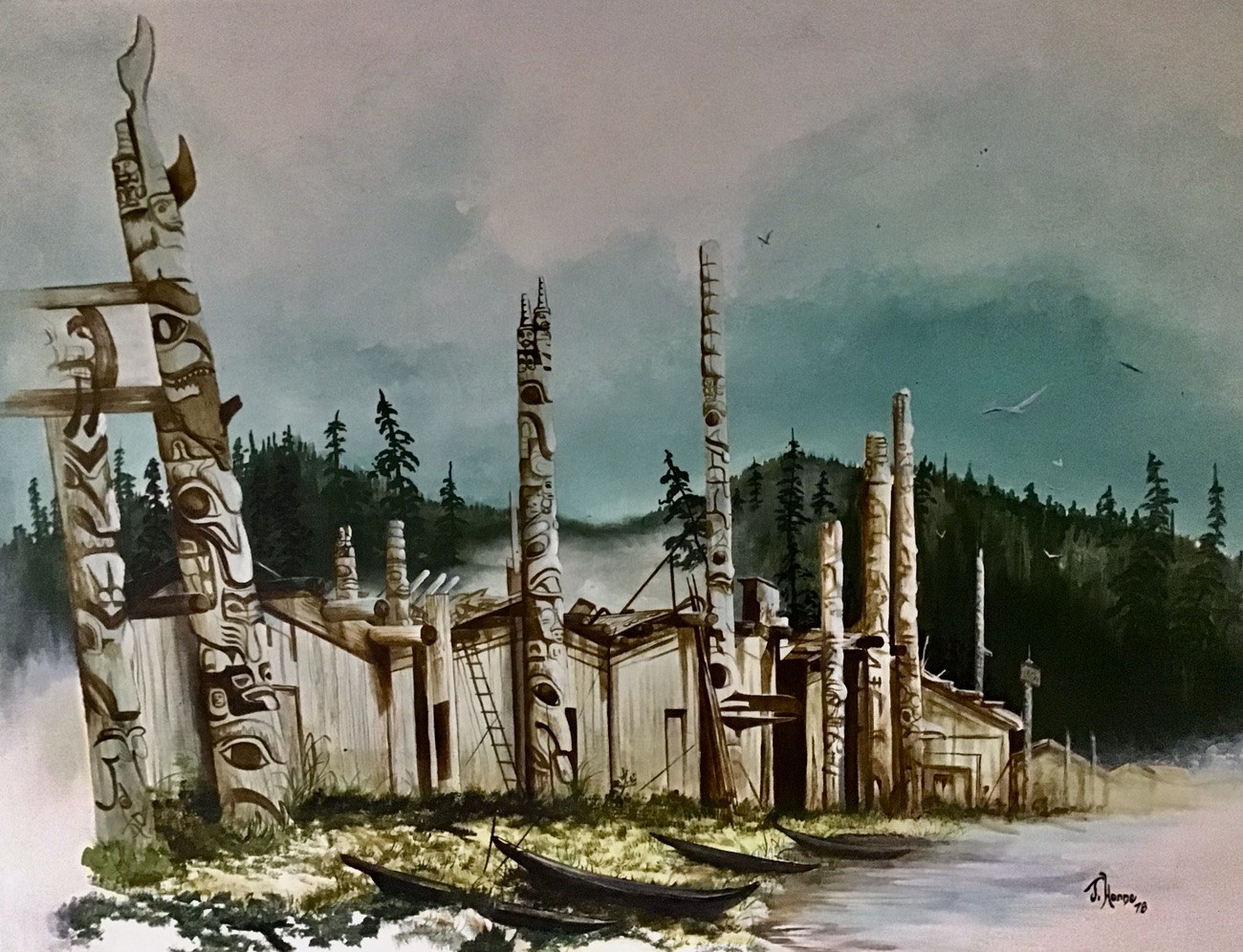
A Day in the Memory of a Westcoaster….
We awoke to a sunny morning, calm blue seas, and a few bright fluffy clouds…. a recipe for a wonderful day exploring British Columbia’s Pacific Northwest waters… So it has been for millennium. Canada’s Pacific coast has over twenty-five thousand kilometres of pristine possibilities to enjoy…. steeped in history, and dotted with villages, bays, fiords, coves, and barnacle encrusted wave swept prominences. Rugged rocky shores offset by stretches of sandy beaches, inspiring to generations of peoples.


Who could forget that first deep breath of captivating salty air or sighting of a humpback whale? A freshness immortalized by artists, novelists, carvers, and poets…. As in John Masefield’s 1902 poem Sea Fever… I must go down to the Sea again… The writer longs to leave a stressful big city existence and return to the simplicity of whales and fellowship of a nomadic sea life.
My wife and I chose to live in a small seaside community… Port Hardy. A prosperous multicultural town on wonderful Northern Vancouver Island… a warm community having proud indigenous roots… The town is built on the traditional territory of the Kwakiutl people; and neighbouring bands of Gwa’sala-‘Nakwaxda’xw, Namgis, Quatsino. Visible today are artistic expressions of First people’s culture forged by centuries of survival & necessity in the west coast’s temperate rainforest climate… Cultural beliefs and means preserved by education, gatherings, and fabulous art displays in the community… regalia, songs, drum music, dances, weavings, totems, silver & copper jewelry, carvings and much more.


Indigenous artwork is seen throughout the Coastal Pacific Northwest , especially in Port Hardy… in schools, homes, shops, and in front of the visitor centre… Meticulously crafted incorporating colours, wood, historical design, and thought provoking spiritual beliefs… Ancestral elders, without written language, passed intricate history, legends, and cultural guidance orally, augmented by skillfully designed art forms that told and tell a story, from generation to generation.


The presence of totems, paintings, and other artistic forms are a welcoming window giving insight to the multicultural nature of the North Island. A busy place founded by first peoples sided by vast unpopulated stretches of untamed marine shoreline, thick evergreen rainforest wilderness; home to diverse & plentiful wildlife.
I wandered up and down the West Coast during my college years, in search of such lofty unfettered coastal settings, that in yesteryears provided all one’s daily needs: food, shelter, cloths, tools… I have been fortunate to have enjoyed decades of remarkable hunting, fishing, and forest foraging in remote places that ages ago fostered unique cultural identities.
I earned college tuition in adventurous natural surroundings, sparsely populated camps, hamlets, villages… from the Pacific to Arctic coastlines… comfortable places where everyone knew each other in the spirit of strong community bonding. The pace of life was slower away from the hustle and bustle of cities.… priorities were tempered by a connection & closeness to the awesome natural outdoors… rivers of steelhead, clam filled shores, oceans of salmon, & forests filled with wildlife splendour.


An especially memorable time was earning tuition on Haida Gwaii, nicknamed Canada’s Galapagos because of its exciting ecological wonder. The group of islands were formally called Queen Charlotte Islands, and situated across the Hecate Straight from Prince Rupert. This unique archipelago was created by uprising plate tectonics eons ago. A temperate utopia, glaciers moreover bypassed it affording a distinctive ecological flora & fauna unseen elsewhere on the coast… numerous rare plant and animal species & subspecies survive to this day that preexisted the frozen rigours of the Ice Age. Imagine the thrilling awe walking in a virgin forest on thick pillow-like moist green moss between huge 70 metre Stika Spruce trees up to 700 years old.


Haida Gwaii intrigued me after reading a book called This Is Haida by Anthony Carter, printed in 1968… The author describes the past and present artistic culture of Haida people. Colourful photos accompany essay narratives, showcasing outstanding spiritual beauty that touches all who visit and live there. I resolved to work on the Islands and did…. behind the historic hamlet of Skidegate, nested on the sandy southwest shore of Haida Gwaii’s Graham Island… a remarkable Haida community named after an earlier village Chief. Forty-six years ago a friend, knowing my passion for the island’s culture painted this article’s cover art from an old museum 1878 photo.


Coastal British Columbia has endless possibilities for the fortunate seeking natural village life, and a connection to the wild kingdom…. I will never forget magical wildlife moments around Vancouver Island… a whale’s unexpected visit and announcing their arrival with a loud whoosh, forcefully blowing a cloud of misty breath… Who would not be uplifted by a raft of frolicking Sea Otters, carrying pups on their chest… or a Steller Sea-lion’s huge mass. Simply awesomeness that indelibly etches a lasting memory in one’s mind.


As a youthful dreamer I couldn’t see enough of the coast…. And I leaped at a chance to earn tuition logging on a remote coastal sidehill above the grassy flats of Moore Cove… hard character building work in camp set up in an unpopulated mainland coastal location, south of Prince Rupert. The cove was home to oodles of wildlife: shore birds, ravens, eagles, geese, seals, salmon, deer, black & grizzly bears, beaver, wolves…. I took every chance to get out there exploring forest game trails around the cove… Wildlife seemed to be as curiously interested in me as I was of them… Miles and miles away from city lights and noise wildlife behaviour seems to change… and too, the stars overhead take on an unimaginable brilliance, a sparkling dome of tiny diamonds from horizon to horizon of a midnight sky. And to hear the howl of a timbre wolf echo through forest blackness is stunning, yet bristles neck hair… the silence afterwards palpable and eerie! I enjoyed every moment logging until the season ended with the first snowfall. We worked 12 sweaty hours a day, and reenergized at full course dinner tables…, as much fine food as one could devour. Roast beef, steaks, turkey, pies, cakes, donuts…. Eggs, bacon, pancakes… Camp food was absolutely gourmet!
Later, another coastal opportunity arose commercial fishing on the FV Jolly Roger, a sleek teak 50’ freezer troller, with the Svoboda family…. An unforgettable and productive seven month salmon season. We filled the holds with salmon, trolling up and down Vancouver Island’s wild west coast… along the way we encountered sea lions, sharks, sea turtles and giant basking sharks.. the connection with marine life polishing an indescribable memory of ocean splendour. Out of sight of land we fished tall cresting waves and then calm mirror seas… the Jolly Roger’s spotless white hull, stabilizing poles, teak upper structures, and self bailing deck was built for foul weather…. It’s bow design capable of slicing through rough seas effortlessly while maintaining a steady course. We fished successfully and visited friendly coastal hamlets & villages all along Vancouver Island’s west coast: Bamfield, Tahis, Kyuquot, Esperanza, Uclulet, Hot Springs Cove. We worked to the steady purring of a Gardner diesel, and spent shore days hunting deer & elk, or trapping crab & prawn. It was an excellent seamanship learning experience with a fabulous family… lessons I carry to this day.
Fast forward to my professional career (as an Advanced Life Support Airevac Attendant) before retirement… Over the course of twenty years I would fly into these same small coastal outposts, villages, and camps in a humanitarian capacity, evacuating patients by air ambulance.


Flying in fast efficient specially outfitted Bell 222 helicopters and Citation lll jet aircraft….I enjoyed the absolute privilege caring for patients in their vulnerable moments, visiting remote coastal medical clinics & hospitals, such as Alert Bay, Bella Bella, Bella Coola, Haida Gwaii…. through fog, wind, & storm our teams earned patient trust. Here was honed a spiritual and respectful connection that began in my college wanderings… a firm appreciation for coastal first peoples, history, Mother Nature, the land, and the sea.


Today I still seek out new and remote places to explore… The Pacific Coast has offered humanity a home for thousands of years, and evidence of first peoples culture is out there in seemingly inhospitable bays, inlets, and fiords. A notion readily apparent by ancient artwork (pictographs) that I and a good friend found boating in an inlet that shall remain nameless. This paintwork, some estimate to be 500 to 1300 years old, is awesomely still recognizable and provides a time capsule of First People’s dynamic presence on the Pacific coast…..


Numerous renderings are painted on shear granite walls in the same area we explored… apparently using red ochre colour from natural minerals found in the area…. Pictographs are said to be the oldest and most widespread First People’s tradition.
Imagine the storms, wave action, and extremes of foul weather these artistic impressions survived. If only they could talk… explaining the motivation behind the artist’s thoughts. Was it sadness or celebrating gladness? Are they messages for travellers, perhaps stern warnings, or simply musings of an ancient gifted person on a bright sunny morning with calm blue seas and a few bright fluffy clouds…. an artist’s recipe for a wonderful day painting on a granite canvas in British Columbia’s Pacific Northwest bountiful coastal waters… So it has been for millennium.
Well, I hope you enjoyed this memory moment… but the sun is now high, tides are ebbing… time Rosie, Chris and I venture out and spend a fine day looking for new and interesting outdoor adventure… Perhaps beach combing and photo exploring… clam digging the Cluxewe Salt Marsh, or crabbing on the west coast.
Isn’t the Pacific Northwest Grand
Safe Travels
Gord Patterson
Photos © Christine Patterson