

A Day with British Columbia’s Coastal Grizzlies…
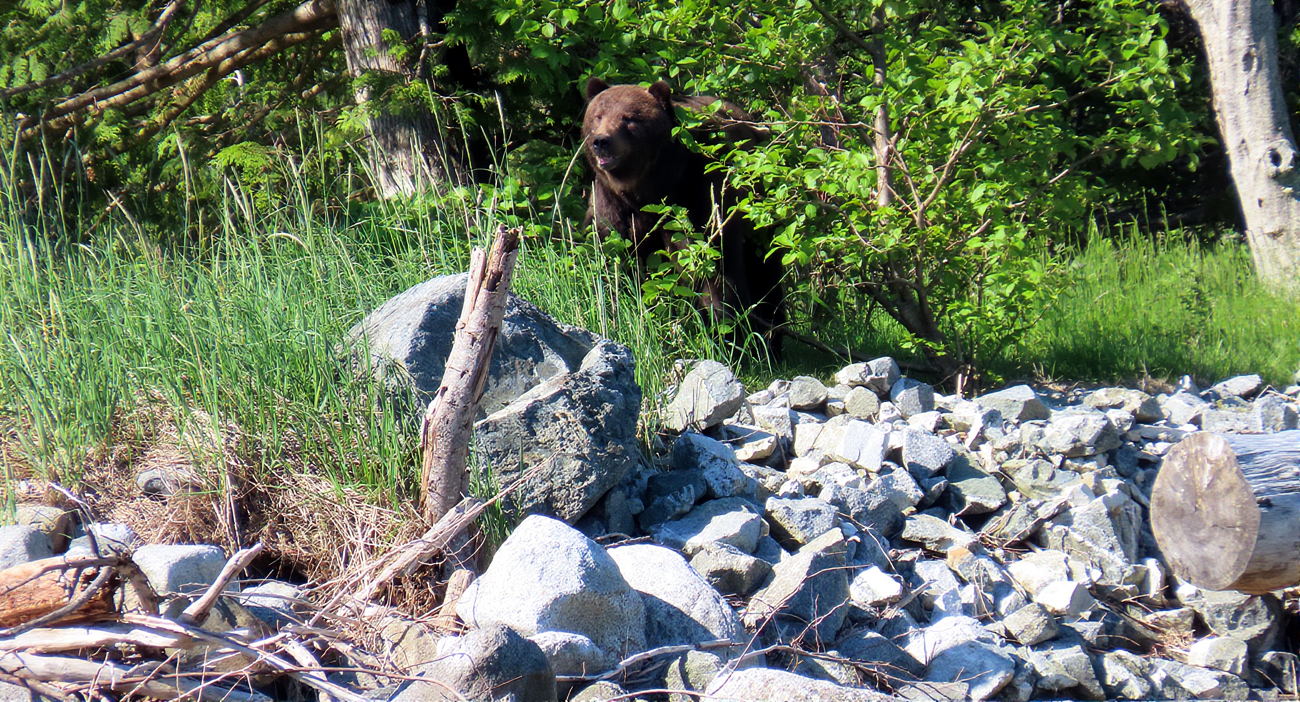
There is a story to be found in every corner of the Wild Kingdom, and today was no exception. The three of us were drifting a remote BC inlet.. floating twenty metres from shore in a small aluminum boat. We were hoping to photograph wildlife along this lonely stretch of beach front, the water was mirror calm, picture perfect weather… Perhaps we’d be fortunate to see a bear, moose, deer, or otter. Then one hundred metres away a great bear came into view! Chris saw him first…and pulled our eyes to attention. Even from this distances in the safety of our boat he loomed large, imposing, and fearsome, causing our pulse to rapidly increase.
The sun was high and warming as the grizzly bear emerged out of the trail’s shadows… a sanctity of vibrant leafy low-bush and tall evergreen trees… He was greeted by chattering squirrels, and piercing seagull cry’s. Crows, and raven were quick to vocalize their annoyance as he headed towards the estuary, a favourite summer feeding area for bears…. But today, food was far from his mind… a primeval stirring was in the hot moist June air; an irresistible restlessness felt throughout wilderness forests, valleys, and river estuaries. It is the mating time of the most powerful and dangerous animal in British Columbia’s Wild Kingdom… the mighty Ursula Horribilis.


He moved over logs and seaweed covered boulders with deliberate well placed steps of massive paws, sunshine highlighting the glossy dark brown fur covering his hulking body. We could clearly see glints sunlight reflecting off piercing brown eyes as he looked our way. This was a Grizzly Bear… an incredible 400 kg of powerful muscle, sinews, claws, teeth and fur.
He walked on all fours, a mass over a metre high at the shoulders. His flanks brushed both sides of the trail’s lush green foliage, yet he moved with purpose, silently… immense shoulders and hindquarters rippled with each move forward. This great bear was in prime shape… he briefly stood on his hind legs to rub against a fir tree… stretching over two metres tall he was a well proportioned marvel of the Wild Kingdom, agile, and intelligent. He was a grizzly king, fast and cunning with capacity for 60 Kph bursts of speed to capture large prey, moose, elk, deer, and goats. However, this morning he was focused and preoccupied… he had romance on his mind…


The boar has traveled to this bay numerous times over the past decade, in search of a mate… re-marking the trail with his scent warding off interlopers. He preferred a lonesome lifestyle… and had earned the title “king of the mountain” by right of combat. He feared nothing… leaving warnings for others to stay away: claw marks three and a half metres high on tree trunks for all to see… a beware sign young bears feared and respected. “This is my territory and I wish to be left alone”.


Stopping short of the clearing’s edge, his huge front paws tipped with 10 cm claws sank into the moist ground. Like a monarch he swung his massive head with slow all seeing side to side motions, surveying and sniffing the air, cataloguing all that was seen and unseen before him. He knew we were there… His sense of smell is capable of identifying danger or food from many kilometres away…. his excellent eyesight confirmed what his nose had already told him, there was a female in heat on the beach!
He was filled with clear resolve and wanted her… a Cinnamon female grizzly with telltale signs she was in estrus, and waiting for the great boar… she sensed his presence and coyly grazed on sedges, small crabs, mussels, and other morsels of shore life. She was a beautiful healthy sow about half his weight at 250 kgs. She instinctively knew the estuary contained essential minerals and nutrients to support reproductive vitality. With a single paw she effortlessly moved a huge 150 kg boulder to access nourishing choice sea-life hidden underneath.
In the mountains the Grizzly king killed only what he needed and constantly explored his feeding grounds, a territory that could be four thousand square kilometres… He had learned humans were a curiosity, wanton, and unpredictable and distrusted them, going to great lengths to avoid human contact. Today however, he left the comfort of his alpine domain to visit the fiords with a primal irresistible urgency to mate. He was focused and driven, eating only what was absolutely necessary… seeking only a fulfillment of Mother Nature’s law of procreation. He would forego a solitarily existence for a week to sire offspring with his chosen mate.

The great monarch could sense other other males in distance parts of the estuary, yet he was privileged by size and proven by combat… They would stay away knowing he had earned the right to breed. They would not challenge him this day… affording his royal status respectable distancing. The great Grizzly then stepped out into the sunshine to begin a week long courtship with his chosen Cinnamon companion. He would mate with her many times over the next few days… afterwards he will make the long trek back to the solitude of his mountain domain.

There is order and symmetry in the Wild Kingdom …. purpose, beauty, hierarchy, and seasonal adaptations assuring continuance of the circle of life. Grizzly Bears are a vital part of nature’s plan… They are a sub species of the North American Brown Bear, Ursus Arctos, and commonly called a Grizzly or Ursus Arctos Horribilis. This is the only subspecies found in British Columbia, yet it plays a vital wilderness role regulating healthy populations of animals preyed upon. From herbivore standpoint he would disperse during his lifetime mountains of berry and other seeds in his scat throughout the forests, meadows, and lowlands.
Grizzly bears (Ursus arctos horribilis) are a North American subspecies of the brown bear. Known for their impressive strength and distinctive “grizzled” appearance, they are key indicators of healthy ecosystems.
Fur colour is usually brown but can range from black to almost white.


While a smaller Grizzly and larger Black can be of similar size, the distinguishing features of a Grizzly Bear versus a Black Bear (Ursus Americanus) is his facial profile. A Grizzly’s face is typically “dished-in”, and a large hump of muscle is normally present on both male and female shoulders.
Opportunistic Omnivores: While they are apex predators, roughly 80–90% of their diet actually consists of vegetation like berries, nuts, roots, and grasses. They also hunt mammals and feast on salmon during summer runs.
Grizzly Bears once roamed over most of the western Canada, from the Pacific coast east to Manitoba, extending southward into the United States. British Columbia Grizzly Bears historically occurred throughout the Province, however populations are greatly reduced and considered locally extinct in some areas of the south and southcentral British Columbia (the lower elevations of the Okanagan, the Lower Mainland, and parts of the Caribou).
We encountered another simply amazing grizzly sow and two cubs that wonderful day. Female grizzly bears with cubs are known for their fiercely protective instincts, making an encounter with a female with cubs particularly hazardous.
Parental Instincts: Female grizzlies are devoted mothers, and ferociously protect cubs from potential threats. Cubs stay with their mothers for two to three years, learning survival skills before striking out on their own.
It is fortunate we were in a boat seemingly out of harms way. A mother bear is highly vigilant and closely monitors her surroundings, with a keen instinct and ability to detect any potential danger to her young. If she perceives an unfamiliar presence, especially that of a human, she may very well interpret this as a threat. In such cases, the bear’s natural response is to place herself between the perceived threat and her cubs, often displaying warning signs such as huffing, jaw popping, or bluff charging to scare off the intruder. Such behaviours are intended to protect the cubs at all costs. Defensive behaviour in mother grizzly bears can quickly and suddenly escalate if the threat persists, and aggressively attack to eliminate the danger…. regardless of the actual risk posed.
Encounters with a sow with cubs are among the most dangerous types of bear-human interactions, as the mother’s primary concern is the safety of her offspring rather than her own well-being. To reduce the risk of conflict, it is essential for hikers, campers, and outdoor enthusiasts to be vigilant, make noise when moving through bear habitat, and avoid approaching or surprising bear, especially those with cubs. Respecting the protective nature of mother grizzlies and black bears, is key to safely coexisting with these iconic Canadian wildlife species.

Bears, from an anatomical point of view, have carnivore digestive systems, but are omnivorous and many populations are primarily herbivorous. This is not to say they do not kill… indeed grizzlies are effective predators of moose and caribou, and coastal populations feed heavily on spawning salmon.
Female bears usually have their first litters at 6 years of age, litter sizes are 2 or 3, every 3 or so years. She comes into heat and mates in May – June – July however, the embryo doesn’t implant in the uterus until between October and November. This is called delayed implantation. The embryo only begins to develop when it is implanted and cubs are born in January or February in the sows winter den. Grizzlies hibernate for up to 7 months each winter, and cubs emerge with their mothers in the Spring.
Hibernation (Torpor): They spend 5 to 7 months in winter dens in a state called torpor. Unlike true hibernators, they can be easily awakened. During this time, they do not eat, drink, or go to the bathroom.


Today Grizzlies are a protected species in British Columbia,… an estimated 16,000 remaining. They live approximately twenty-five years While a natural mortality occurs in bear populations, most grizzlies die from human activities. Human incursions into grizzly bear habitat including mining, forestry, agriculture, residential development, and recreation degrade habitat quality for the normally solitary animals, increasing mortality.
Lifespan: They live 20 to 30 years in the wild, though some have been recorded living up to 39 years.

Encountering a grizzly bear in its natural habitat is a breathtaking moment, evoking a mix of awe, fear, and amazement. The sheer size and power of these magnificent animals can trigger memories of both wondrous and tragic stories of human encounters. I have been fortunate and all my grizzly sightings in the northern BC and Northwest Territories have been fully rewarding. Grizzlies normally avoid human contact and primarily only seek to protect themselves, their young, and food cache. Never-the-less tragic encounters can and do occur when bears are startled or feel threatened. Left undisturbed, these remarkable creatures live peacefully, playing vital roles in maintaining ecological balance across their wilderness homes.
To ensure grizzlies continue to thrive for generations, education and conservation are essential. Learning about bear behavior, respecting their space, and supporting conservation efforts, such as protected areas and habitat restoration, we can reduce human-bear conflict and preserve these wild treasures. Responsible stewardship will allow us today and future generation the privilege of coexisting with one of nature’s most awe-inspiring inhabitants.
Safe Travels
Gord
Gordon F. W. Patterson
Photos © Christine Patterson