

Moss a Curious Entity
I was reading a field guide reference called “Mosses Lichens & Ferns” and the publisher’s cover note described moss as a “relatively inconspicuous” plant.! This label hardly fits their striking presence in British Columbia’s Pacific Northwest.
The vivid greens of moss dominate landscapes everywhere, from gardens to woodland paths, drawing the eye, sparking curiosity, and occasionally frustrating homeowners. These ancient, non-vascular plants, classified scientifically as Bryophyta, flourish in British Columbia’s humid climate, weaving living carpets that shape our unique ecological identity on the North Island. Mosses soften trails with every shade of green imaginable, from emerald to olive and gold, turning logs, stumps, and rocks into buoyant sculptures. Their extensive presence creates wonder, wrapping forests and woodlands in a tenacious but gentle quilt of many colours.
Mosses are small non-flowering plants which produce spores and have stems and leaves, but don’t have true roots.
Remarkably, moss is an ancient lower plant form, dating back 450 million years, yet has survived higher plant orders and thrived through a range of drastic climate changes and ice ages. World wide they comprise of 15,000 to 25,000 species, and occur on every continent and in every ecosyste habitable by plants that use sunlight for energy!


Scientists estimate there are perhaps five hundred distinct moss types on Vancouver Island, each species possessing unique physical attributes and ecological roles. A few of the Island’s species are rare or endangered yet our Coastal Western Hemlock forests are said to harbour British Columbia’s highest concentration of bryophytes!
Moss is and of itself is not harmful to trees, but its presence can sometimes be a sign of other issues. Moss can appear on trees that might be suffering from rot and decay
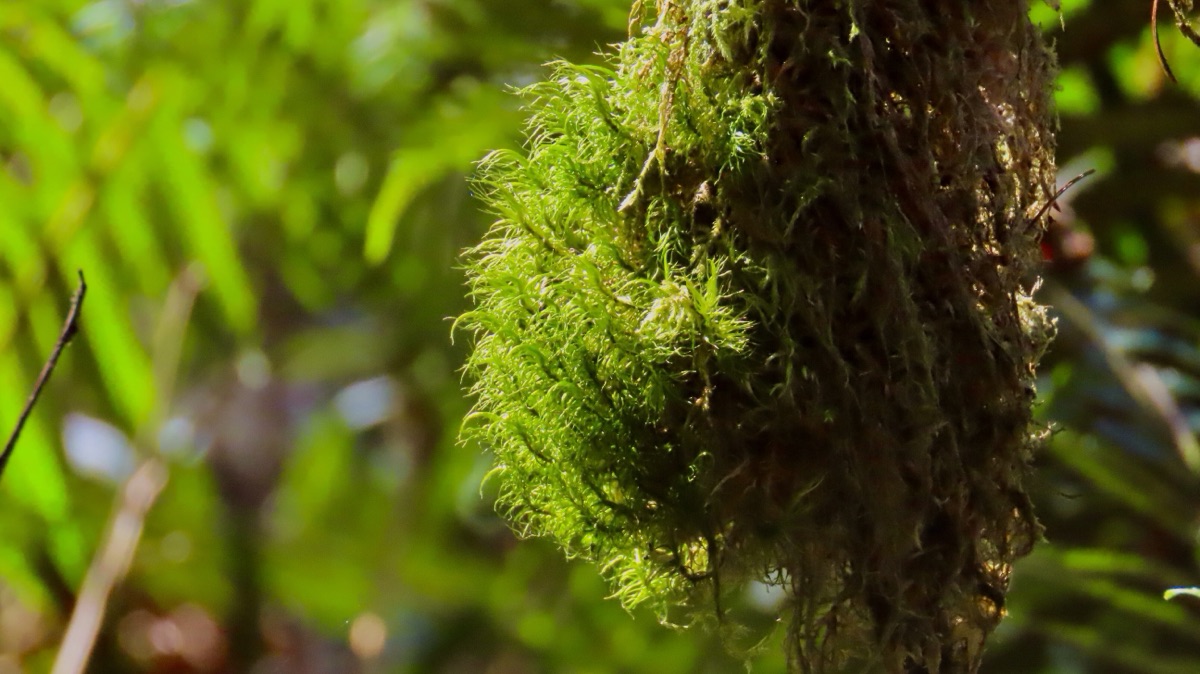
The diversity is evident with every step (no pun intended): stair-stepped moss varieties spread in lush layers on and alongside trails, delicate cat’s-tail moss drapes from maple, alder, and conifer branches, and the profuse tangles of sphagnum moss create sponge-like mats in boggy wetland clearings . Such abundance and variety is not limited to remote forest interiors; they spill over into rain-soaked suburban lawns (right Allan?) seep into crevices in stone retaining walls and colonize shaded surfaces of cedar fences. The sheer roof top persistence of moss is emblematic of the Pacific Northwest’s temperate climate, yet an amazing example of ecological tenacity.


The success of moss is attributed to its capacity to thrive in copious rainfall and high humidity locations, which enables its “fluid growth” forming thick dense mats on the ground, enveloping tree trunks, rock surfaces, logs, and debris. Atmospheric moisture and rainfall is more than just an enabler, it is the essential ingredient, allowing moss to flourish amidst the mists and drizzle that define British Columbia’s coastal climate we know so well. Moss not only enhance landscape visually but also perform essential ecological functions for example, regulating and holding onto moisture supporting a multitude of organisms. Few other plants bridge the interface between soil, air, and water as effectively as moss. Its presence helps stabilize soil in areas susceptible to erosion, moderates and cools a forest’s microclimate, and creates micro-habitats for countless invertebrates and reptiles. Amazing eh!


When inspecting a curious tuft of moss up close, it teems with minute forms of life, mites, bugs, snails, slugs, and micro-organisms highlighting the interconnection and foundational role moss plays in an ecosystem’s biodiversity. Their capacity for water regulation plays a vital role in the development of new ecosystems being among the first plant colonisers of disturbed sites, such as logged off slash areas, or land traumatized by forest fires. They stabilise a regrowing platform that assists new plants to repopulate deforested lands.


The structure of mosses is equally amazing and consists of simple leaves and stems lacking the complex vascular tissues, roots, or flowers characteristic of higher plants. They absorb water and nutrients directly through their leaves via cellular osmosis, rendering them highly dependent on surrounding humidity and precipitation. This direct relationship with the environment makes them sensitive indicators of ecosystem health, responding quickly to changes in air quality, pollution, and moisture levels.
Mosses can impact the temperature of the soil, both warming it up and cooling it down depending on the environment.
British Columbia’s diverse climate supports a vast range of mosses, often classified into broad groups based on their growth habits and distinctive colloquial names. Here are a few of the more common of the hundreds Vancouver Island varieties:
- Peat Mosses (Sphagnum) commonly known as Peat or Bog Moss, vibrant green or yellowish or red and form thick, water-filtering mats in bogs and wetlands
- Feather Mosses, Larger creeping, branched species typical of coastal forests.
- Shaggy Moss, characterized by their bushy, irregular branching and “fuzzy” appearance.
- Stair-step Moss, also called Step or Splendid Feather Moss, easily identified by its distinctive “stair-step” branching or feathered patterns
- Oregon Beaked-Moss, Common forest floor flora, often seen in large mats on tree trunks, branches, boulders.
- Red Stemmed Moss, it is recognized by its reddish stems and lush green fronds.
- Haircap Mosses, these are short, upright mosses with stiff, needle-like leaves, common in drier sites, that often dominates post-fire environments.
- Broom Moss, also known as Wind-blown Moss, it looks like a miniature broom because its leaves all point in one direction.
- Cat-tail Moss, A common species found hanging from tree trunks and branches especially here in the Pacific Northwest.
- Badge Moss, Sometimes called Leafy Moss and noted for its distinctive leaf shape.
- Fire Moss, Frequently appears in urban cracks, asphalt or cedar roofs, or disturbed burnt soil.
- Goblin’s Gold, a Rare & Specialized Moss, also called Luminous Moss that glows in dark crevices and is a prized find in BC’s rainforests
———————-
Mosses reproduce via unique methods distinct from those of most other plants and trees, as they lack flowers and seed-producing structures of higher plants. Instead, like fungi, lichen, and ferns, they generate spores, which develop in capsules at the ends of slender stalks following fertilization between moisture dependent male and female organs. Upon maturation, these capsules release spores into the air, allowing new moss plants to establish wherever conditions are suitable, including residential backyards, shaded stone walls, and roof tops. Additionally, mosses are capable of reproduction through a cloning process known as fragmentation, utilizing specialized structures horticulturalists call gemmae; even small fragments can propagate new individual plants. These strategies ensure the continued existence of moss over millennia and their outstanding resilience to environmental challenges.

Beyond their scientific and ecological importance, mosses possess a subtle comforting appeal that continues to attract artists, photographers, and naturalists. In the early morning, sparkling dew drops collect on moss tips, highlighting a beautiful intricate growth pattern, iridescent and glistening like baskets of jewels when illuminated by shards of forest light. Species such as cat’s tail moss create striking visual effects draped from tree branches, while dense sphagnum mats in boggy areas evoke a peacefulness rarely found elsewhere.
Moss can absorb water 25 times its own weight mosses and are practically immune to death. In fact, mosses can lose up to 98% of their moisture and still survive. It has even been documented that mosses left to dry for 40 years have survived after being replenished with water!
The marvels of moss and intricate forest plant life draw Chris, Rosie, and me time and again into forest areas, fostering a deeper appreciation for the complexity of rainforest ecosystems with each outing. Every visit reveals new aspects of these ancient plants: the softness underfoot, the subtle fragrance released after rain, and the visual appeal as sunlight promotes a fluorescent effect across their living form. Mosses may appear humble at first glance, but in their wonderful way, they implore us to slow down, pay attention, and connect with the outstanding rhythms of the land.


At the end of the day we are fortunate to live in this part of the world. The botanical diversity of British Columbia harbours an astonishing range of plant life, from the tiniest fungi to giant rainforest conifers, each playing a distinct role within Earth’s ecosystems. Mosses, in particular are foundational to the health of the Pacific Northwest’s rich rainforests, wetlands, mountain slopes, and even Arctic tundra ecology. Ancient mosses on Vancouver Island contribute to the region’s natural beauty, shaping habitats, supporting wildlife, and maintaining the delicate balance of precious environments. Moss reminds us of the heart of natures anatomy. Their quiet persistence is not only vital for sustaining biodiversity, but also invites us to cherish and protect the intricate web of life that surrounds us.
Safe Travels
Gord
Photos © 2026 Christine Patterson