

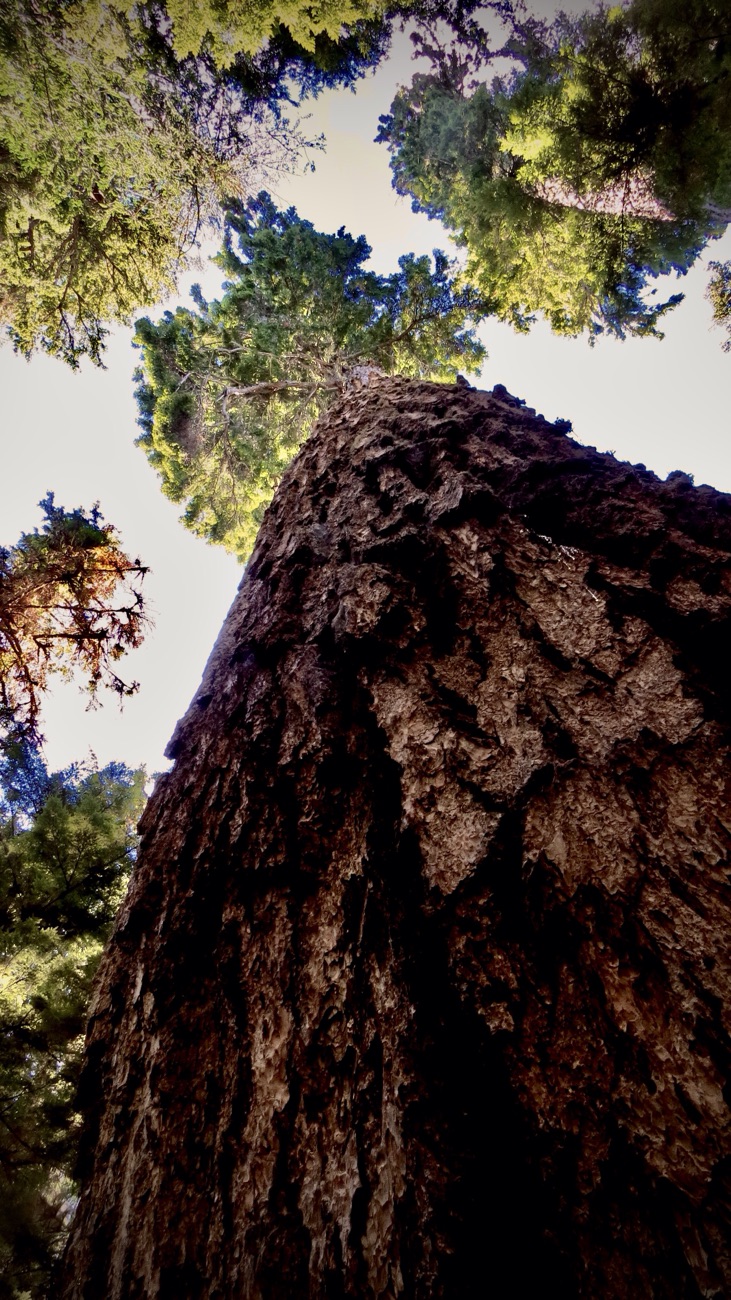
The legacy of an ancient Douglas-fir…
An Old Douglas-fir
The ancient tree stood guard, watching a brilliant sunrise over the Sutton Mountain Range, as it has for centuries. Rays of sunshine reflected off tiny orbs of dewdrops clinging to its high lofty needles, sparkling like diamonds adding a magical ambience to the breaking dawn. A large canopy, a jangle of green, branches, and boughs adsorbed most of the light; only shards to escaped to light up the mossy understory far below.
The tree’s massive trunk, covered in thick gnarly brown bark, stretched defiantly over 80 metres into a cloudless Vancouver Island morning. A broken top, a silent witness to the prosperity this ancient giant has afforded to surrounding conifers: a mix of maturing Red Cedar, Hemlock, and Sitka Spruce. Chris, Rosie and I were fortunate to happen upon this breathtaking treasure, hidden in a forest grove near a nameless lake on North Vancouver Island. The enormous tree is an ancient Douglas-fir and commanded awe from all in its domain.

Six Hundred Years Old
Born before Christopher Columbus, this solitary monarch has weathered over six centuries of storms, climate change, disease, fire attacks… growing taller and stronger while the world around it underwent unimaginable change.
Yet the tree stood strong and rooted… owing its existence to Mother Nature’s fertile ground, the Pacific Northwest’s rain drenched latitudes, and moderate sunshine enabling a tiny winged seed to sproat, grow, and mature into the Douglas-fir’s stately enormity today.


A Unique Species to the Pacific Northwest
Douglas-firs (Pseudotsuga menziesii) are not true firs, but a unique coniferous species native to British Columbia and Vancouver Island. The species is named after Scottish botanist David Douglas who described the unique tree, noting features that prevent its classification as a true fir: most obvious is Douglas-fir cones hang down rather than stand upright on a branch as cones of a true fir do.… and another separating feature are cones that are released intact to fall to the ground, and produce about fifty single winged seeds each that are dispersed by wind in a wide arc.
True endemic firs in Coastal British Columbia are: Ambilis fir (also known as Pacific Silver fir, Abies ambilis), Grand fir (Abies grandis), Balsam fir (Abies balsamea), and Subalpine fir (also known as Alpine fir, Abies lasiocarpa).
Wilderness landscape and forests have been reshaped many times over two millennia, deforested by massive glaciers. Nevertheless small groups of trees survived the frozen climate in small ice-free refuges until they were able to spread once the ice retreated. After the most recent glaciation (twelve thousand years ago) the Douglas-fir became a distinct coastal Pacific and interior evergreen species… alongside cedar, pine, spruce, and others. Rebounding forestation is a living testament to nature’s tenacity and remarkable resilience of Canada’s forests.


A Living Monument
Douglas-firs typically live an amazing 500 – 800 years but can live much longer, and few are documented over a thousand years old. Coast Douglas-fir commonly reach 75 metres tall and 2 metre diameters though maximum heights can reach well over 100 metres and diameters can reach almost 5 meter diameters.
Douglas-fir ranks as the second tallest tree species in the world behind coastal redwood. The largest known Douglas-fir in Canada is in Vancouver Island’s San Juan Valley. It is known as the Red Creek Fir and 74 metres tall and 4.3 metres in diameter. It has a broken top and thought to be over a 1000 years old.
These ancient wonders are far more than mere trees; they are living books… an anthology of ecological history that time chronicles in structure and growth rings. Scientists are able to study growth factors, environmental health, transitional ecological trends, and much more.
The Douglas-fir remarkable structure enable it to remain upright, overcoming natural challenges of storms, wind, and rain soaked foot-holdings. Key to survival is its disease and pest resisting thick bark and a vast network of thick deep intertwining roots that anchor its mass in rocks and crevices. The rooting structures also stabilizes adjacent soils creating stable watersheds for robust undergrowth to flourish. The great conifer is keystone to a delicate ecological equilibrium upon which a healthy forest depends: a self-sustaining biosphere of inter-dependant young trees, ferns, shrubs, mosses, mushrooms, lichens all coexisting in harmony.

Old growth understory is habitat to a multitude of birds and small mammals, a sanctuary for martin, mink, squirrels, deer, bear, elk, and many others who forage in its shadow; a garden of salal, oregon grape, huckleberry, fawn lilies, fungi. Some rare and endangered mammals, reptiles, and birds also depend on old growth forests such as the “Spotted Owl”, and likewise a small mouse like mammal the “Red Tree Vole”, that incredibly lives out their lives high in Douglas-firs canopies reproducing and thriving on needles, dew drops, and other matter (one of the most secretive and poorly studied mammals in North America). Interesting eh!


A Guardian and Protector for Centuries
The magnificent old growth evergreens are symbols of strength, resilience, and continuity, serving as a source of inspiration, cultural beliefs, and respect. To stand in front of a forest giant encourages thoughtful contemplation of human existence and personal interaction with a natural environment centuries older than ourselves. They are vital to a balanced interconnected forest ecosystem, the tree’s massive structure and canopy producing a temperature regulating microclimate enabling to a healthy self-sustaining biosphere… For generations upon generations this old giant has been a father, guardian, nurturer, and protector of the forests natural balance, cradling habitat enjoyed by countless life forms.
Old Growth Described
British Columbia defines an old growth primarily based on age, and typically 250 years. (Interior Douglas-fir forests are old at 140 years). Yet here we are today standing in front of an incredible 600-year plus living monarch amidst a maturing rainforest of younger conifers of various ages and species. In this regard an old growth definition is expanded by some scientists to include other factors including different aged trees. Old growth forests have a multilayered canopy of various aged growth that allows sunlight to penetrate to the forest floor, promoting diversity of plant and animal communities. In comparison, second-growth forests moreover feature closed canopies that limit sunlight, resulting in dense growth inhibiting light access to the forest floor, reducing biodiversity within all the forest layers. Additionally, old growth forests usually have fallen large dead trees in a state of decay that recycle nutrients back to the soil; factors critical to self-sustainment of a healthy biosphere. Second-growth forests summarily have dense single layer canopies due to the uniform age and height of their trees, and thereby reduced biodiversity.
As British Columbia forest classification standards evolve beyond age-based criteria, the presence of this ancient Douglas-fir we enjoyed today underscores an ecological, social, and cultural importance of protecting healthy biosphere’s existence if only to fully understand the dynamics and interdependencies of temperate rainforest ecosystems.
Cultural Value of Ancient Trees
Sustainable forestry practices increasingly recognize the importance of balancing resource extraction with conservation, ensuring that local economies benefit in the long term from its lumber value, while protecting irreplaceable forest ecosystems. The ancient Douglas-fir we stand before is a living witness and guiding presence, bridging tradition and history. Its towering form not only defines human cultures, but also safeguards the delicate ecological balance that sustains natural life on Vancouver Island, British Columbia, and beyond. As we look ahead, the legacy of this remarkable tree in the shadow of the Sutton Range by a nameless lake holds promise for future generations amazement, study, and an understanding of forest giants practical and intrinsic ecological value for years to come.

Today’s adventure was truly a transformative experience. Walking beneath the canopy of the old Douglas-fir connected us with the intricate balance of life that defines nature and Vancouver Island ecosystems. Every step revealed new wonders: ferns unfurling, flowering lilies, wonderful sounds of songbirds, animals that scurried away, and some who didn’t.
Vancouver Island forest giants and their ecosystems offer endless opportunities to inspire… a living classroom to deepen our understanding of ourselves and the natural world..
Safe travels,
Gord
Photos © 2025 Christine Patterson. All rights reserved