

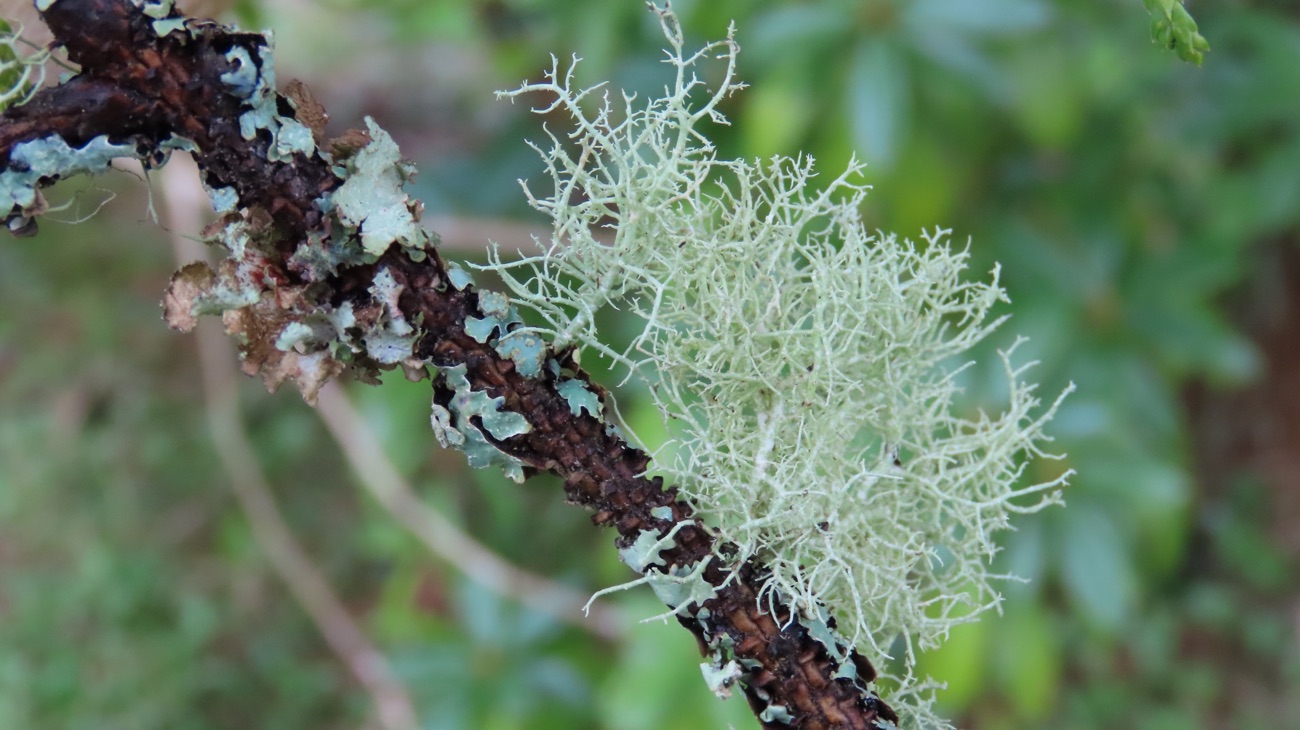
Lichen, a Curious Fungi & Plant Composite….
The diversity of vegetation in British Columbia’s Rainforest is amazing, especially in the cool humid environment of North Vancouver Island’s coastal forests. During snow free seasons, hikers are rewarded by volumes of lush foliage sporting unique shapes and designs, scattered between tall evergreens….. Wonderful flora pleasing to the eye with exciting shades of green and brown: light, dark, vibrant or soothing pastels… And amongst woodland greenery are curious plant-like organisms called lichen; one of the most poorly understood flora of the forest macro and micro world! Scientists (lichenologists) are only now documenting the full context of lichen existence. Fascinating lichen are much more than just reindeer food.

Recognizing Lichen
Pacific Northwest lichen are perhaps most recognizable as ribbons of pale greenery draped from conifer or deciduous branches, often waving in a breeze. Also commonly seen are small pale greyish apple sized balls of thready stuff clinging to branch surfaces, alongside leafy lettuce-like organisms. I find lichen a fascinating curiosity of nature… especially the mysterious centuries old rock lichen..


Whatever these intricate organisms are, they stimulate your imagination by unique fragile beauty that grabs your attention. Scientists have documented over twenty-five hundred different types of lichen across Canada, and many more are yet to be studied and identified.
Lichen Structure
But what exactly are these delicate multidimensional organisms? Do they have mythical origins referred to as Witches Hair, Reindeer Food, Old Man’s Beard, Mary’s Tears, Fairy Cups, etc. Are they plants, fungi, or other type of entity? How old are they, how do they grow, what is their role in forest ecosystems…… so many questions?

Fairy Cup lichen and other species like reindeer lichen contain didymic acid, and they were once used by herbalists to treat tuberculosis. They are called fairy cups because they are said to resemble the tiny cups that pixies or wood fairies sip morning dew from.
The short answer is lichen are not solely a fungi nor a plant! They are a composite of both… The organism consists of a fungal supporting latticework called a thallus, made up of fibres called hyphae. This thallus provides a home for either a partnering algae or cyanobacterium. Together they marry into a symbiotic relationship creating a mutual dependency on each other for food and life sustaining needs.
The Fungal Partner Determines Lichen Shape
The type of fungi determines the organism’s shape, as well as making a rhizine rootlike structure (usually) to attach on substrates such as branches, bark, soil or rock. Lichen by itself do not harm their forest host. If a tree dies, it is usually caused by another organism! In fact some lichen actually insulate their hosts from environmental temperature and pollution challenges. Interesting stuff eh!
The fungus rootlike cortex sources water and mineral necessities, and partnering algae or cyanobacterium, through a photosynthetic ability, provides bioenergy. The fungal species determines the scientific name assigned to the particular lichen.
Primary Lichen Classification
Lichens are interestingly classified “by shape” into three basic types:
- Crustose…. Flat crusty looking one dimensional entity pressed on a rock or other substrate
- Foliose… Leafy looking two dimensional structures
- Fruticose… Shrubbery stringy three dimensional organisms
There are other sub classifications having a mix or other unique features of traditional classification shapes


- Squamulose, having small, scale-like plates that often overlap like shingles, an intermediate form between crustose and foliose.
- Leprose, powdery lichens that lack a structured outer layer
- Jelly Lichens, becoming jelly-like when wet because they contain a large amount of certain cyanobacteria which swell with water.
- Placodioid, a specialized crustose form where the edges are lobed and slightly raised
It is a complex continuously evolving field
Finding Lichen
I have fabulous memories walking beside carpets of Arctic lichen, watching caribou graze on the choice tundra flora…. An absolutely essential food staple for the constantly moving masses of migrating caribou. Many other Arctic inhabitants, such as hares, muskox, lemmings, geese enjoy its culinary benefits. Fortunately the slow growing tundra lichen are remarkable survivors of short growing seasons and huge fluctuations in temperature. In turn, many wildlife species are dependent on lichen as an aid to their survival.


In British Columbia lichen are noticeably abundant in exposed alpine topography, coastal marine areas, cool rainforests, and boreal regions. Their nutrient rich structures are equally an important staple food source for many BC herbivores during harsh winters; moose, elk, caribou, deer, birds, rodents…. Wildlife such as hummingbirds and squirrels also makes use of lichen as soft, warm insulating nesting material.


Interesting Lungwort Lichen is a symbiotic relationship between three entities: a fungus, a green algal partner, and a cyanobacterium, involving members of three biological kingdoms! It is very sensitive to air pollution and a healthy presence is considered an indicator of an unpolluted ecosystem. It is found in mature, or old-growth forests. Lungwort has been used as a source of dye, and in traditional herbal medicine to treat ailments like lung diseases and asthma. Some brew it as a tea.
Lichen Benefits
Little known are the surprising direct benefits of lichen to humanity. Especially in the battle against climate change. The structures have a biochemical ability to sequester carbon and other substances directly from the atmosphere, especially pollutants. Some are thought to have medicinal properties, yet others are poisonous… For example, Old Man’s Beard (Usnea) is said to contain organics believed to fight infection causing germs, relieve coughs, and other health related benefits to obesity, pain relief, and wound healing. However, as yet, there are no scientific documents to support medical use as such.
The Wolf Lichen pictured here is deserving of mention in that it is toxic to carnivores, and some first peoples used it to poison arrowheads. It’s rich in vulpinic acid, which is bright yellow and gives Wolf Lichen it’s colour. The name comes from a past European practice of using the lichen to poison wolves. The vulpinic acid is toxic to meat-eating mammals. It is not toxic other mammals, and like most lichens it is eaten by deer and elk with no ill effects. Scientists believe only a small number of lichens are poisonous, the wolf lichen being a readily identifiable by its bright yellow colour. It is extremely resilient and when conditions are right can survive for many centuries.
Observers often associate lichen with old, decaying or dead trees and assume that a trees demise was caused by the lichen. However, many lichen tend to appear on trees that are already in decline.


Lichen Age
Lichens can be extremely long-lived, some are considered to be among the oldest living things on earth. Their longevity is a subject of ongoing study, and some Pacific Northwest rainforest lichen such as the specklebelly lichen may live as long as their tree host. Some Map Lichen found in the Arctic may be thousands of years old. Some Antarctic lichens too have estimated ages of a few thousand years! Lichens pictured here such as Rock Lichen grow very slowly, some taking twenty-five years to grow 1 cm. Others such as Methusula’s Beard can add metres to hanging ribbons over the course of a season. Lungwort lichen grows slowly about “4 mm” annually! Imagine the age of the Lungwort pictured in this article… perhaps decades old!
In summary lichens are an amazing composite organism consisting of fungi, algae, or cyanobacteria (or both). They are essential contributors to healthy ecosystems, as well as fighting climate change by sequestering atmospheric carbon. Their full value to humanity is presently under study by scientists called lichenologists. Unmistakably the presence of lichen adds health, curiosity, and intrigue to the beauty and wonders of Nature.
Their resilience in harsh environments underscores the importance of conserving these unique organisms as environmental indicators of health and human well-being. The mere presence of lichen in cities and forests are bioindicators of air quality, helping scientists monitor pollution levels. They provide food and habitat for various wildlife species. And for humanity, lichens have through the ages held cultural, medicinal, and economic importance, being used by indigenous peoples in traditional remedies, dyes. Lichen embodies flexibility and adaptability.
Isn’t Nature Grand!
Safe Travels,
Gord
Gordon F. W. Patterson
Photos © Christine Patterson